
Industrial executives are under pressure.
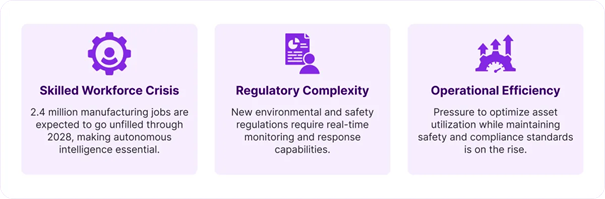
Rising volumes, constrained budgets, and widening workforce gaps are stretching operations to the limit. At the same time, a new generation of AI and automation is shifting the landscape.
Robotic Process Automation (RPA), once a breakthrough, is no longer enough. Intelligent Digital Workers are redefining what’s possible.
In the early wave of automation, organizations leaned on RPA to streamline repetitive tasks such as invoice processing, regulatory reporting, and data transfers. It delivered value, but as agentic AI evolves at the speed of change, RPA’s limits are becoming clear.
When RPA Isn’t Enough: Tackling Complexity with Intelligence
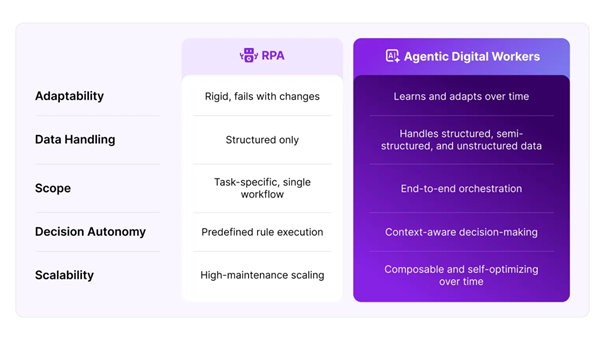
RPA follows rigid, predefined rules, can’t handle exceptions easily, and struggles with operational complexity across suppliers, dispatch, inventory, and customer orders.
That’s where agentic industrial digital workers come in and shine. They represent the next evolution of automation intelligent, self-learning, and purpose-built for industrial operations. Because digital workers are agentic, this helps them orchestrate workflows across multiple systems, break data silos, and free human teams to focus on higher-value tasks, unlocking entirely new operational capacity.
When RPA Isn’t Enough: Tackling Complexity with Intelligence
Even the most well-run operations struggle with handoffs, exceptions, and bottlenecks. Delays in supplier orders, missed dispatch windows, or inventory gaps can cascade into missed customer commitments and revenue loss. Digital Workers address these gaps by orchestrating tasks across systems with speed, consistency, and governance.
Example: A digital worker reconciles supplier orders across 50 vendors, coordinates dispatch schedules, and updates customer records automatically. Operations that previously required hours of human oversight now run flawlessly and continuously.
They also capture institutional knowledge that often lives in spreadsheets, emails, or among key employees. By embedding operational intelligence directly into workflows, digital workers minimize errors and streamline processes, freeing human teams to focus on strategic, high-impact decisions.
Double the impact: How Digital Workers Collaborate
A high-volume industrial distributor can deploy one digital worker to manage customer orders and another to handle inventory replenishment.
Not only will on-time delivery improve, but error rates will also drop significantly, and human teams will be free to focus on strategic initiatives.
Gartner predicts that by 2028, 15% of day-to-day operational decisions will be executed autonomously by agentic AI. For a 1,000-person operation, that could translate into $7.5–$12.5M in savings per year, without adding headcount.
Beyond direct labor savings, digital workers prevent late shipments, stockouts, and process order corrections. Scaled across multiple sites, these improvements generate multi-million-dollar efficiency gains.
Built for Industrial Complexity
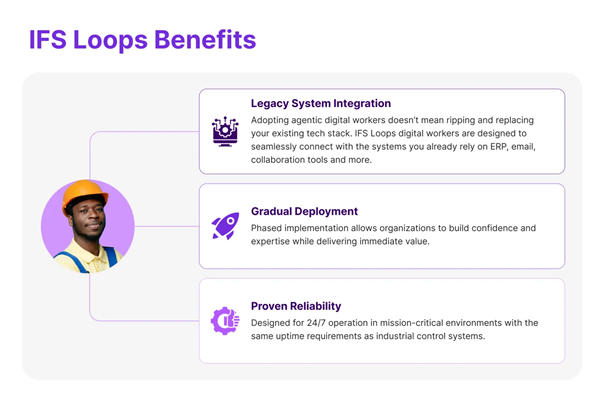
IFS Loops digital workers are designed for real-world industrial operations. They operate natively within IFS Cloud or without. Powered by a secure, governed platform, they tap into 65+ connectors which further helps them automate supplier orders, dispatch, inventory, and execute customer order management, continuously and reliably. With built-in governance, audit trails, and guardrails, digital workers augment human teams without replacing them, allowing staff to focus on judgment-driven decisions while operational workflows run flawlessly.
Why RPA Is A Great Start But Not The Stopping Point
Organizations rely solely on RPA risk bottlenecks, errors, and slower order cycles. Industrial leaders who adopt digital workers early gain a measurable edge.
Market insight: According to McKinsey research, “agentic AI has the potential to generate $450 billion to $650 billion in additional annual revenue by 2030.At the same time, cost savings could range from 30 to 50 percent, driven by automation of repetitive tasks and streamlined operations.”
RPA was a milestone, but the truth is clear. In modern industrial operations, RPA can no longer keep pace. It struggles with exceptions, requires constant human oversight, and is limited to rigid, linear workflows.
Digital Workers don’t just automate, they orchestrate, adapt, and scale across complex operational processes. They handle supplier orders, dispatch, inventory replenishment, and asset intelligence analysis with contextual awareness and consistent execution, results beyond the reach of traditional RPA. For any organization serious about operational excellence, relying solely on RPA is choosing yesterday’s solution for tomorrow’s challenges. Automation that can’t adapt is a thing of the past . Industrial leaders are moving fast, and those who cling to RPA risk falling behind.
SOURCE: Somya Kapoor (2025 October 24) RPA vs Digital Workers: Why Intelligence Beats Automation. IFS Blog. https://blog.ifs.com/blog-rpa-vs-digital-workers-ifs

